
Saltillo Tile Restoration: Bringing Handmade Mexican Tile Back to Life
Saltillo tile is hand-fired, deeply porous and full of character — which means it stains, dulls and wears faster than any other surface in a San Diego home. Here is how professional restoration brings it back without replacing a single tile.
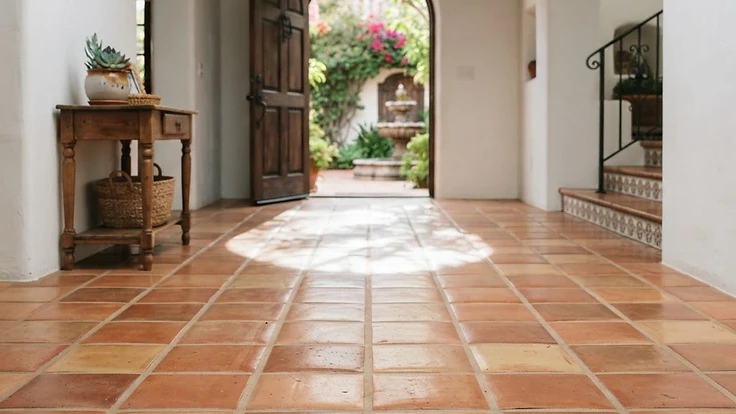
There is no tile quite like Saltillo. Hand-pressed from clay in Mexico, fired in wood kilns, and laid across the entryways, patios and kitchens of half the Spanish-style homes in San Diego — each piece is a slightly different colour, a slightly different shape, and unmistakably handmade. It is one of the most beautiful surfaces you can own. It is also one of the most demanding, and we see more Saltillo in trouble than almost any other material. The good news is that the same character that makes it vulnerable also makes it remarkably restorable.
Why Saltillo behaves differently from every other tile
Saltillo is terracotta in its rawest form. Unlike fired ceramic or porcelain, it is not vitrified — it is never fully sealed by the firing process. Under a microscope, a Saltillo tile looks like a sponge: open pores run all the way through the body. That is why it stains so fast, why it drinks water, and why a spilled glass of red wine or a wet potted plant left overnight can leave a permanent shadow. It is also why it was traditionally finished with a thick topical sealer or wax — without that barrier, the clay itself is exposed.
The other thing owners discover is that Saltillo is soft. It dents, it scratches, and in high-traffic lanes the surface wears down to a paler, rougher version of itself. None of that means the tile is failing. It means the finish on top of it has.
How Saltillo gets into trouble
Most of the Saltillo we restore is suffering from one or more of the following:
- A failed or peeling sealer. The old topical coating has gone patchy, yellowed, or started to flake at the edges, leaving some tiles dull and others still glossy.
- Deep stains. Water rings, plant stains, pet accidents and food spills have soaked past a worn sealer into the clay itself.
- Efflorescence. Because Saltillo is so porous and often laid over a concrete bed, the same white mineral bloom that attacks patios pushes up through the tile.
- Wear patterns. Traffic lanes have lost their finish entirely, while edges under furniture still look fine — leaving the floor looking tired and uneven.
- Damage from the wrong cleaner. Acids, vinegar and supermarket "tile" cleaners have stripped the sealer and begun to etch the clay.
Why restoration beats replacement
Ripping out Saltillo and relaying new tile is expensive, dusty, and rarely improves the floor. New Saltillo looks exactly that — new — and loses the patina and colour variation that makes an older floor so desirable. Restoration keeps the character and the original installation, and it addresses the actual problem: the worn, stained or peeling layer on top of the clay, not the clay itself.
How a professional Saltillo restoration works
Restoration is methodical, and it is one of the more satisfying transformations we do.
- Assessment. We identify what is on the tile right now — wax, acrylic sealer, oil-based finish, or nothing at all — because the stripping method depends entirely on the existing coating.
- Stripping. A professional stripper and controlled agitation lift the old sealer, wax and embedded soil off the surface and out of the pores. This is the step that reveals the true colour of the clay underneath, which is almost always richer than the dull finish suggested.
- Stain treatment. Individual deep stains are treated with poultices or targeted chemistry to draw the discolouration back out of the clay where possible.
- Neutralising rinse and full dry. Saltillo must be completely dry before any new finish is applied — trapped moisture is exactly what causes efflorescence under a fresh sealer.
- Re-sealing. A finish matched to how you live with the floor is applied: a penetrating sealer for a natural, matte look, or a topical finish for the warm, soft sheen that most owners associate with classic Saltillo. Often both are used — penetrating protection first, a finish coat on top.
Keeping it looking good
- Re-apply the finish before it wears through. Once the clay is exposed, staining starts again.
- Never use vinegar, acid, or abrasive scouring powders — they strip the sealer and etch the clay.
- Wipe spills immediately. Even sealed Saltillo gives you minutes, not hours.
- Use felt pads under furniture and rugs in high-traffic lanes.
- Lift, never drag, heavy items across the floor — the clay dents.
A well-restored Saltillo floor is one of the warmest, most characterful surfaces in a San Diego home, and with the right finish and a realistic maintenance routine, it stays that way for years. If your Saltillo has gone dull, patchy or stained, a free assessment will show you exactly what is on the tile now and what it takes to bring the colour back.
Want this handled professionally?
Our San Diego technicians clean, seal and restore tile and stone of every kind — with free, no-obligation quotes.