
Why Mopping Makes Your Tile Dirtier (and What Actually Cleans It)
Mopping pushes dirty water into grout instead of lifting it out. Here is why your floors look worse over time, and how professional extraction cleaning gets them genuinely clean.
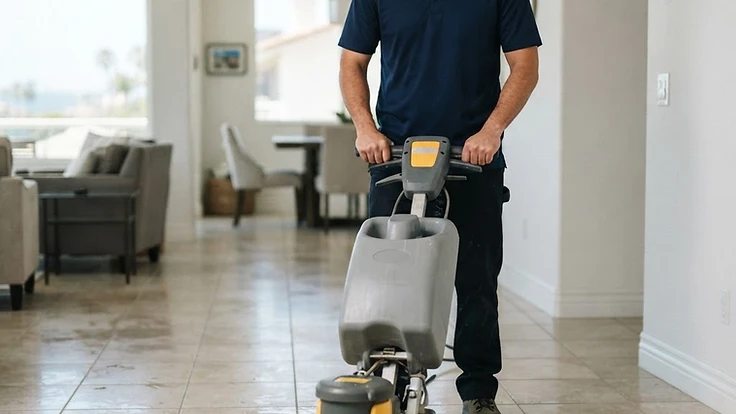
It is the most counter-intuitive thing in home maintenance: you mop the floor, it looks better for a day, and then it looks worse than before — duller, with grout lines that darken a little more each week. The floor is not getting dirtier on its own. Your mop is doing it.
The problem is not effort, it is the method
A mop is essentially a sponge on a stick, and a sponge works by absorbing liquid and then releasing it wherever you press. When you mop a tile floor, you are lifting some soil off the surface — and depositing the rest, suspended in dirty water, directly into the most absorbent part of the floor: the grout lines.
Grout is porous by design. It needs to be, to bond the tiles and flex with the floor underneath. But that porosity means every pass of a mop pushes dirty water into the joints, where the water evaporates and leaves the soil behind. Over months and years, that soil builds up in layers inside the grout until no surface cleaning can reach it. The tile face stays relatively clean while the grout slowly turns grey, then brown, then black.
Why "cleaner" mopping makes it worse
A few common habits accelerate the cycle:
- Using the same water too long. By the second or third room, you are no longer cleaning — you are painting the floor with dirty water.
- Too much water. Flooding the floor gives the grout more to absorb, and water that sits in joints feeds mould and efflorescence.
- Wrong chemistry. Acidic or high-alkaline supermarket cleaners can etch polished stone or strip sealer, opening the pores wider so the next mopping soils the floor even faster.
- Never changing the pad. A soiled mop head is a delivery system for the very soil you are trying to remove.
None of this is a flaw in your effort. It is a flaw in the tool. A mop was designed to wipe a smooth, non-porous surface. Tile and grout is not that surface.
What actually gets a tile floor clean
Professional extraction cleaning flips the process. Instead of pushing dirty water into the grout, it pulls soil and water out of it.
The equipment is the difference. A self-contained, heated extraction unit applies a controlled flow of cleaning solution to the tile face and grout, agitates it to break soil loose, and immediately vacuums the dirty water back out of the joint before it can soak in. Because the soil is removed rather than relocated, the floor comes back to its original colour — and it stays clean far longer, because the grout is not pre-loaded with trapped soil waiting to darken again.
The process is also material-aware. The same chemistry that safely deep-cleans ceramic and porcelain would etch marble or travertine, so the solution, pressure and temperature are matched to the surface first. That is a step a mop simply cannot take.
The order that makes the result last
- Pre-inspection. Identify the material, check the sealer, and note any damaged grout or loose tile before any water touches the floor.
- Extraction cleaning. Heated, enclosed extraction flushes the soil out of the grout and off the tile face.
- Grout detailing. Stubborn lines are treated individually so the colour is consistent across the whole floor, not patchy.
- Neutralising rinse. Residue is rinsed away so no cleaning chemistry is left to attract fresh soil.
- Sealing. A sealer matched to the material closes the grout pores, so the next spill — or the next mop — sits on the surface instead of soaking in.
A floor that stays clean between visits
After extraction and sealing, maintenance genuinely works. A pH-neutral cleaner and a microfibre mop, with the water changed regularly, keeps the surface clean because the soil is no longer trapped inside the grout. Add a yearly professional extraction, and most San Diego floors look like the day they were laid for years longer than a mop ever allowed.
If your grout has gone dark, your floor looks dull within days of cleaning, or you can see clean lanes where furniture was and dark lanes where traffic is — that is trapped soil, and it is exactly what extraction is built to remove.
Want this handled professionally?
Our San Diego technicians clean, seal and restore tile and stone of every kind — with free, no-obligation quotes.